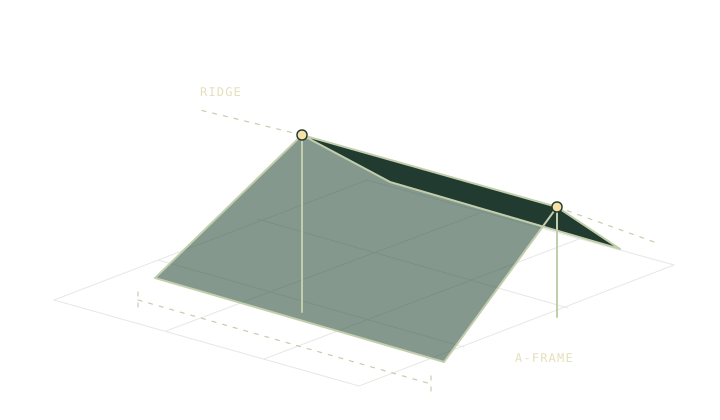
Short answer
An A-frame gets narrower as you move up from the floor. At a height of one quarter of the ridge, you have three quarters of the ideal floor width. Measure the mat, the inflated or lofted sleeping setup and the space you actually need. Compare at that height before relying on floor area.
On this page
Use the height of what goes inside
Take the floor width and ridge height from the A-frame model. Draw a horizontal line at the height of an object under the tarp. The two fabric faces meet that line closer to the centre than they meet the ground. The remaining width is the floor width times one minus the object height divided by ridge height.
For example, a floor width of 2.24 m with a 1 m ridge leaves 1.68 m at 25 cm high. At 40 cm it leaves about 1.34 m. That is the width of the whole section. A person sleeping off centre gets less room on the side closest to the edge, even if the total looks generous.
Try the example mat before measuring your own
In Shelter Studio, choose Explore in 3D, then show the sleeping mat. Use the end view to see the cross-section and the overhead view to compare the mat length and tarp outline. The mat is a fixed example. It represents a rectangle with thickness so you can see what happens near the fabric.
If the centred mat intersects a panel or projects beyond an end, the comparison identifies which dimension is short. If it fits, measure your own kit anyway. Add the space for bulky gear and for entering and leaving without leaning hard against the fabric. Changing the ridge height can make that tradeoff easier to see.
Check length separately
A narrow mat fits across some short pitches, but it still has to fit along the ridge. A 1.85 m mat under a 2.1 m long ideal pitch leaves 25 cm in total, or 12.5 cm at each end if centred. That number describes the tarp edge at the floor. It says nothing about wind-driven rain through the opening.
The tarp size guide separates the width and length decisions. If two people need space, mark where each will lie and where the gear fits before counting the nominal area. An oblong mat and a triangular cross-section can create awkward gaps even when the total square metres appear sufficient.
Verify on a real pitch
Raise the tarp in a place where you can measure it safely. Inflate the mat, put the bag on top and look along both ends. Compare what happens when the mat is centred and when it has to move to one side. Check the ridge, edge positions and slack in the actual fabric.
Then evaluate the pitch against the expected conditions. Pitching for wind explains why orientation and exposed openings can change the choice of shelter. If the model says the space is only just big enough on paper, test how much practical clearance remains when the setup is less tidy.
Write down the thickness you tested at. A measurement taken with a deflated mat misses the clearance the real arrangement needs.
Common questions
Does the 3D mat represent all sleeping mats?
It is a centred example, 1.85 m long and 0.55 m wide. Measure your own setup and leave room for the sleeper and any gear.
Why check a sleeping bag above the mat?
The tarp slopes inward as it rises. The bag, shoulders or pillow can meet the fabric even when the mat has space on the ground.
Sources
Published 9 November 2026. Reviewed 9 November 2026. Sources support the figures quoted; they do not endorse Trailwright. Report a correction through the owner’s contact page.