Short answer
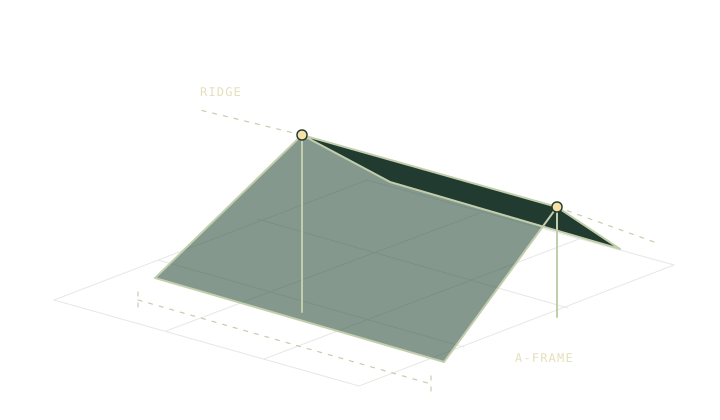
For an A-frame with the edges on the ground, raising the ridge pulls both edges inward. A 3 m wide tarp gives about 2.24 m of floor width with a 1 m ridge, and about 1.66 m with a 1.25 m ridge. Pick a height after checking the width you actually need at mat and shoulder level.
On this page
Keep the fabric and length fixed
Lay out which dimension goes across the ridge and which runs along it. The first determines the size of the two sloping sides. The second determines how long the ideal floor is. Swapping the edges of a rectangular tarp can give a very different result from changing just the height. See the tarp size comparison before entering the dimensions.
For a 3 m cross-ridge width, each sloping panel spans 1.5 m from ridge to ground. The horizontal half-width is the square root of the panel length squared minus the height squared. Double that answer for the full floor. The A-frame geometry note shows how the triangle works.
Compare two possible heights
At 1 m high, the half-width is the square root of 2.25 − 1, or about 1.118 m. At 1.25 m it is the square root of 2.25 − 1.5625, or about 0.829 m. The floor loses about 58 cm of total width across those two settings. Each ground edge moves by about 29 cm.
Open Shelter Studio and increase the height to 1.25 m. Compare both the width number and the 3D view. The plan along the ridge stays 3 m long. The steeper fabric angle buys more headroom at the centre but makes the available width narrower at the edge.
Check the space above the ground
The tent floor can fit a mat outline while the fabric touches the edge of a bag above it. A ridge height sets how quickly the inside narrows with height. The sleeping mat clearance worksheet compares two heights above the floor and explains how to measure the tallest object you need underneath.
Try one repeatable yard setup before leaving. Put a tape measure where the floor edge should fall. Set up the mat and bag you intend to carry. Leave space for gear and for moving around at the entrance. Record the pitch you used so the same check can be repeated after changing a tarp or sleeping system.
Leave room for a real campsite
A flat floor, straight ridge and fixed ground edges make the calculation easy to compare. A real pitch might sit on sloping ground, have seams that pull differently or use anchors that are a little too far apart. Wet fabric and the actual geometry of a suspension or pole can change the outline further.
Use the model to rule out awkward measurements before going outside. Then judge the site itself. The campsite choice note covers surface and exposure, which the model cannot see. Have another pitch or site in mind if your preferred ridge and edges cannot fit on durable ground.
You can record both pitches with their measured floor widths before packing. If the actual tarp gives different widths, use your test dimensions and keep the calculator as a way to compare how another height will move the edges.
Common questions
Is fabric width the same as floor width?
Only in the limiting case of a nearly flat tarp. Every increase in ridge height uses part of the fabric slope to reach the ground.
Does raising the ridge increase floor area?
For the ideal ground-edge A-frame the floor area narrows at the same length. An open pitch with raised edges needs a different model.
Sources
Published 9 November 2026. Reviewed 9 November 2026. Sources support the figures quoted; they do not endorse Trailwright. Report a correction through the owner’s contact page.