Short answer
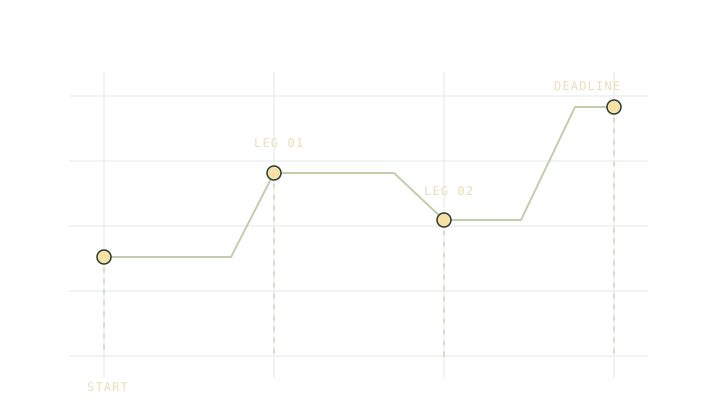
A workable itinerary names the trailhead, the checkpoints you will recognise, the time you expect at each and the hard deadline for finishing. Put stops and slow ground into individual legs. Hold a separate reserve for the unknowns so that an optimistic finish time cannot quietly consume it.
On this page
Start at the finish
Write down what imposes the deadline. A park gate may shut before dark. A return bus may leave well before the last usable light. Check the current times and account for the walk between the route finish and where the group needs to be. Enter that earlier finish on the trip planner.
Then choose a reserve you can see and keep. A 16:30 deadline with a 40-minute reserve gives a target of 15:50. If the route estimate ends at 16:10, it has spent 20 minutes of the reserve even though the deadline still looks reachable. The turnaround time note covers how to use a hard time in the field.
Put in the legs you can recognise
A useful waypoint is where somebody can say the group has reached it. A signed junction or the far side of a bridge is easier to verify than a distance on a phone screen. Break the route there. Name each leg for its end so the timetable makes sense in the order you read it.
For a leg of 3.2 km with 200 m of ascent, 4 km/h gives 48 minutes of flat walking. An allowance of ten minutes per 100 m adds 20. Add a ten-minute stop and that leg occupies 78 minutes. An 08:30 start gives 09:38 arrival and 09:48 departure. See how to split a route for the cases where a separate row is worth the effort.
Make a late decision while still at home
Calculate when you can last reach the junction and still finish with your reserve intact. The planner works backwards from the target finish, keeping the stop at that junction and the remaining legs. It uses the same pace assumptions in both directions, so a delay does not magically disappear.
Write the alternative beside the timetable. An example would be “If we miss the saddle time, return to the original trailhead by the approach.” Check the return time separately. The bailout note helps when an apparent shortcut has a crossing or access issue.
Make the copy useful to someone else
Include the trip date, map or route name, planned alternative and the best place to expect a check-in. In the planner, the route notes and check-in fields travel with the printed or exported copy. Share only the information the recipient needs.
Follow a check-in plan that says what your contact should do if you miss the agreed time. A timetable and a contact plan are two different things. Before leaving, check that the shared version matches the one you carry, and that everyone in the group knows the fallback.
If the timing hinges on one awkward leg, write down why. The estimate for a steep rocky section deserves a different margin from the estimate for a road walk. Keep these local assumptions close to the leg they affect.
Common questions
Which deadline should I enter for a bus?
Use the time you need to reach the stop, allowing for boarding and any walk from the trailhead. Keep a separate margin for unexpected delays on the route.
Does the trip planner send my itinerary to anyone?
The plan stays in the browser until you print or export it. Send a copy to the person you have chosen and agree on the check-in yourselves.
Sources
Published 9 November 2026. Reviewed 9 November 2026. Sources support the figures quoted; they do not endorse Trailwright. Report a correction through the owner’s contact page.